AI-WORKER — autonomous SDLC orchestrator
A Rust daemon that takes a project from requirements to merged PRs by driving Claude Code and local models through a gated software lifecycle.
Background
Most coding agents answer one prompt. AI-WORKER runs the whole lifecycle: ingest an existing codebase or raw requirements, produce a design prototype, pick a stack, write the architecture, plan sprints, author tests, then execute tasks in parallel and ship through CI and an end-to-end Playwright matrix. A human approves each phase gate.
It is a Rust workspace of six crates: a daemon with HTTP and WebSocket APIs, a CLI, a terminal UI, an MCP server so Claude Code or an IDE can drive it, a prompts crate and a shared core. A React cockpit is embedded in the binary.
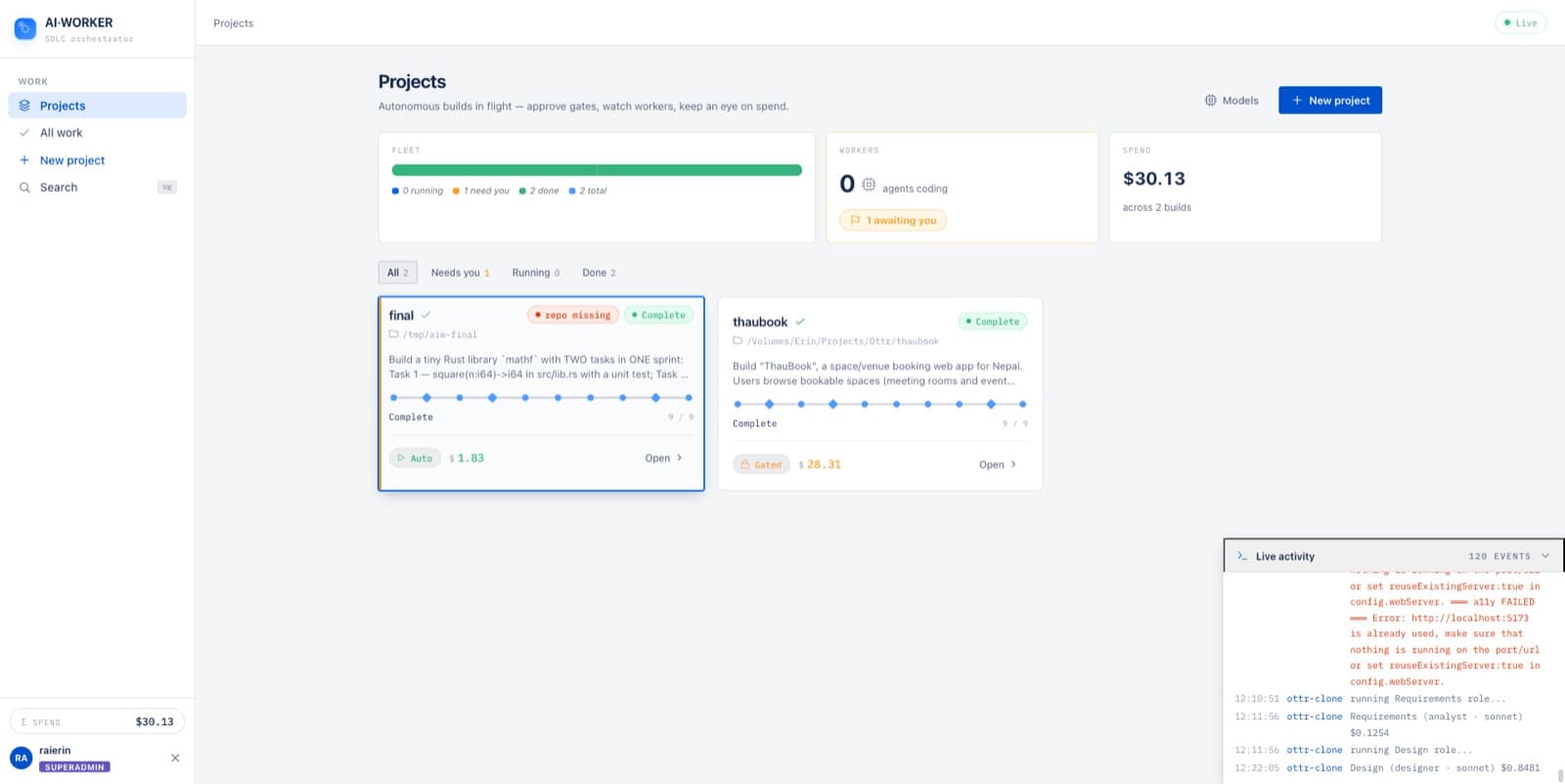
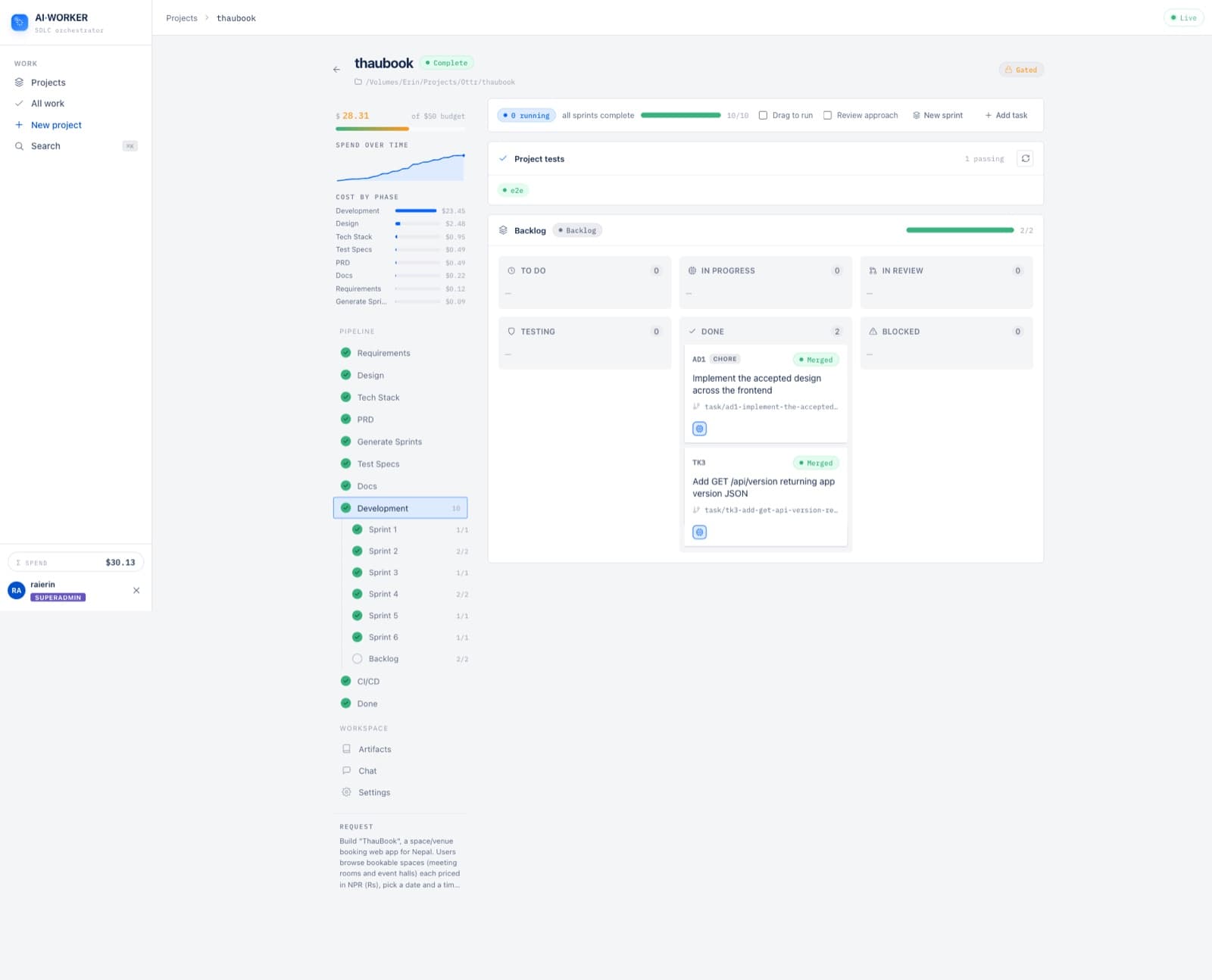
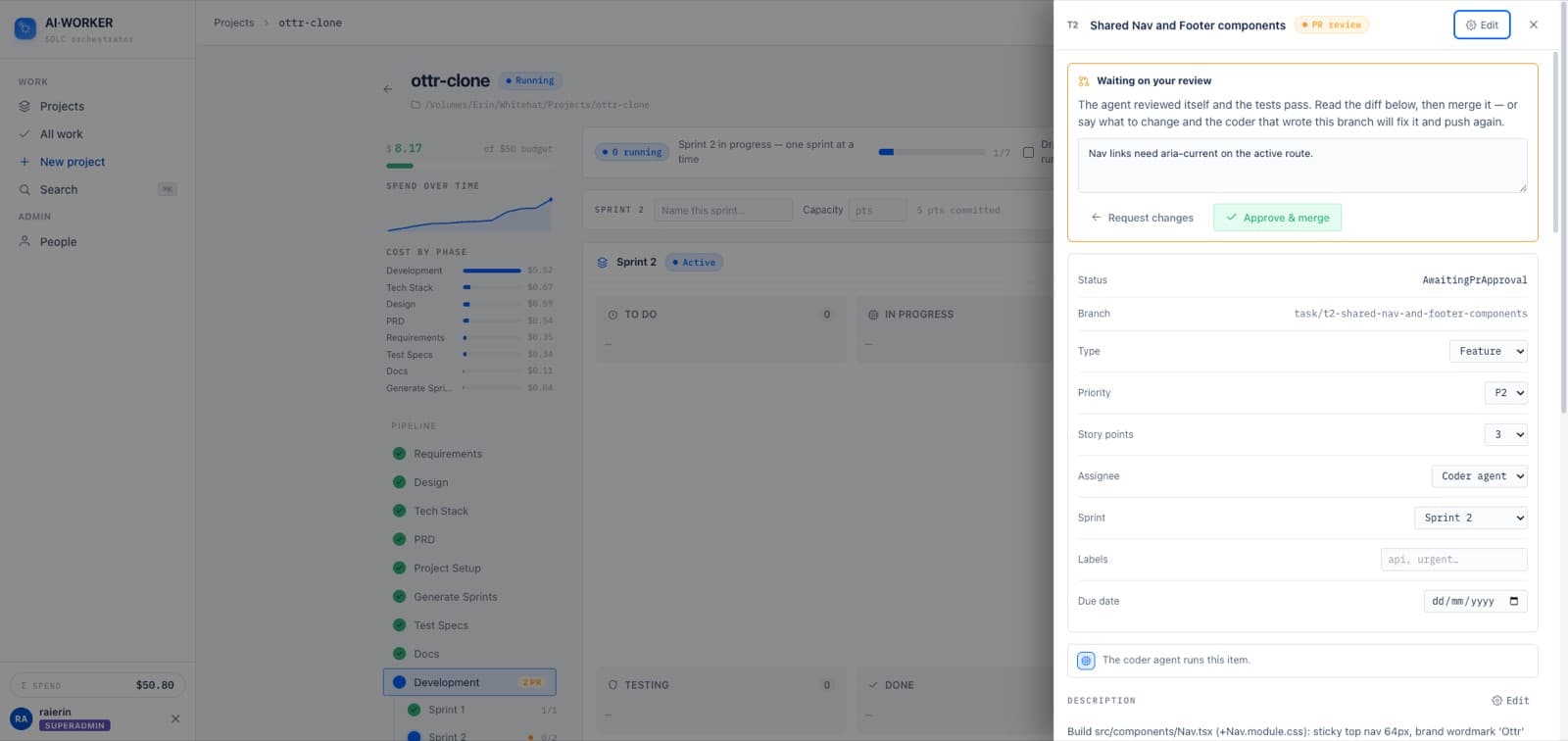
Screens
The problem
At work I had watched a team run OpenClaw agents as a simulated company. It produced a lot of output and very little that merged. The failures were structural, not model quality: no gate between phases, no isolation between parallel workers, requirements silently dropped between the analyst and the coder, and no idea what a run had cost until the invoice arrived.
I wanted a system I could leave running overnight on a real repo and trust three things in the morning: nothing merged without a human seeing it, every explicit requirement was either satisfied or flagged, and the bill was known before it was spent.
Approach
- Model the lifecycle as an explicit state machine. Ingest, Requirements, Design, TechStack, Architecture, SprintPlan, TestAuthoring, Docs, Execution, CI/CD, E2E, Done. Every transition is a human gate with role-based seats, optional quorum and escalation.
- Isolate workers with git. Each task runs in its own worktree on a task branch. The loop is coder, tests, resume on failure, open a PR with gh, reviewer agent, human PR gate, serialized squash merge. Two workers cannot corrupt each other's tree.
- Make the model pluggable per role. Eleven roles, each routable to Claude CLI, an OpenAI-compatible endpoint (Groq, Gemini, OpenRouter, Ollama) or Aider. For local models that lack tool use, a custom tool-calling loop lets them edit files. A fallback decorator switches models on rate limits.
- Add a constraint ledger. Explicit requirements are extracted verbatim, carried into every coder and reviewer prompt, and scored pass or fail per task. The result is a compliance matrix instead of a vibe.
- Track cost as a first-class value. Per-item estimates from a regression over story points, routing advice by model, a stall watchdog, and auto-pause and resume on usage limits so an unattended run does not burn the budget.
- Sandbox it. macOS Seatbelt profiles plus a hostname-allowlisted egress CONNECT proxy. A CI gate script runs secret scanning, clippy with warnings as errors and a custom async lint.
Architecture
Outcome
- Four real projects built unattended from a one-paragraph brief to merged PRs with passing Playwright suites: a recipe app, a static clone of a company site, a Go and React grocery store, and a CI smoke target.
- Sixty-phase build journal that documents the system by rebuilding it, so a new contributor or a new agent can reconstruct it phase by phase.
- A clean rewrite (new-ai-worker) started in September 2026 on the same six-crate layout, folding in what the first version taught.
Lessons
- Gates matter more than models. Swapping a stronger model changed output quality a little. Adding a reviewer agent and a human PR gate changed the merge rate a lot.
- Local models are usable for narrow roles if the prompt is short and the tool loop is yours. They are not usable as drop-in replacements for Claude in the coder role.
- Cost tracking has to be built in on day one. Retrofitting it meant re-parsing months of CLI output.